1 · Pending
The client published the signal claim. The server has not replied yet (network race or queue). Initial pipeline state.
Cipher Edge is the installed workspace for Backtest Lab, profiles.json packs, AutoMT planning, AI-gated alerts, Paper Mode execution and local review. Public proofs sit behind the official signal stream as a trust layer; the terminal is the product you use every day.
Windows 10/11 · 863 KB · offline installer (.msi)
Cipher Edge is not just a public signal page. The customer installs a working desktop application for building strategy packs, importing approved profiles, running AutoMT scenarios and reviewing local decisions.
Use the Backtest Lab to generate approved strategy packs, or request a profiles.json file by email to import into your application.
Turn approved profiles into a multi-symbol plan. The terminal handles symbols, timeframes, gates, cooldowns and Paper Mode execution from the same workspace.
The user sees alerts, positions, decisions and outcomes inside the installed app. Public proofs validate Cipher Edge's official stream; local history explains what happened on that terminal.
The installed terminal is the product; the public verifier exists so customers can inspect the official Cipher Edge signal stream instead of relying on screenshots, edited posts or unverifiable win-rate claims.
A signal published at 14:00 can be edited or "discovered" at 14:30, after price has moved. Without a cryptographic anchor proving when it was emitted, there is no serious way to validate the history.
Showing 3 out of 10 trades is statistically irrelevant. Without a complete, ordered, time-anchored history, there is no track record — only a hand-picked best-of.
Backtests live on the provider's server. Strategy parameters can change between yesterday and today and be "rediscovered" afterwards. You are asked to trust a black box.
These states belong to the official Cipher Edge signal stream and exist to assess provider integrity; they do not suggest that the customer's local machine is anchoring private actions on-chain. Five states keep the public stream clear and verifiable:
The client published the signal claim. The server has not replied yet (network race or queue). Initial pipeline state.
The server re-ran the strategy on the same candle. Side, price and profile hash match. The canonical leaf is written to the local database. Two independent paths agree the signal is real — but it is not immutable yet.
The server re-evaluation diverged: different side · profile hash mismatch · missing or inconsistent candle. Click to see the exact rejection code. This is the most important state: it is the public admission that something did not match.
The daily Merkle root was built and this signal is one of the leaves. Anchored on Base L2 + Bitcoin OTS. Cryptographic finality — verifiable forever.
The signal does not contain required metadata (strategy, timeframe, profile hash, candle close). It is excluded from the audit pipeline and will not be published.
Official Cipher Edge signals can be hashed, grouped into a Merkle root, anchored externally by Cipher Edge and verified directly in the customer's browser. Verification is client-side; public anchoring is operated by Cipher Edge. The page at /proofs/ provides transparency, while the desktop app remains the customer's product.
SHA-256.
The page lists each official signal ID. Click any row and the browser walks the Merkle path against the anchored root.
Open the verifier →Cipher Edge ships as a desktop terminal: Backtest Lab, profile packs, Paper Mode execution, multi-exchange data, AI-gated alerts, AutoMT planning and position management. The public proof layer supports provider transparency, while the application is where the customer works.
Run reproducible backtests across 18+ strategies and 5 timeframes. Export approved configurations as a profiles.json pack that the live runtime consumes.
Bayesian gate per symbol with win-rate priors and EWMA. It handles cold-start, adapts to your history and supports tunable thresholds for AutoMT, scanner and symbol-specific contexts.
Three independent filters that complement the AI Gate. Configurable in Settings → Trade Gates.
Break-even, trailing stop, TP extension and time stop are applied by default and configurable per strategy. Defaults were calibrated with months of Paper Mode audit.
One terminal, four venues. Symbol, candle, ticker and funding-rate normalization is handled by adapters dedicated to each exchange. Positions keep their lifecycle tied to the origin exchange, ensuring consistent replay even after you change the active venue.
The terminal centers you on local analysis, alerts and positions. Public proofs validate the official Cipher Edge stream, allowing provider reputation to be assessed without additional costs.
One window brings together market watch, chart, execution, position manager and bottom tabs for history, signals, radar, management, replay and settings. The proof badge is auxiliary context; the center is the control surface.
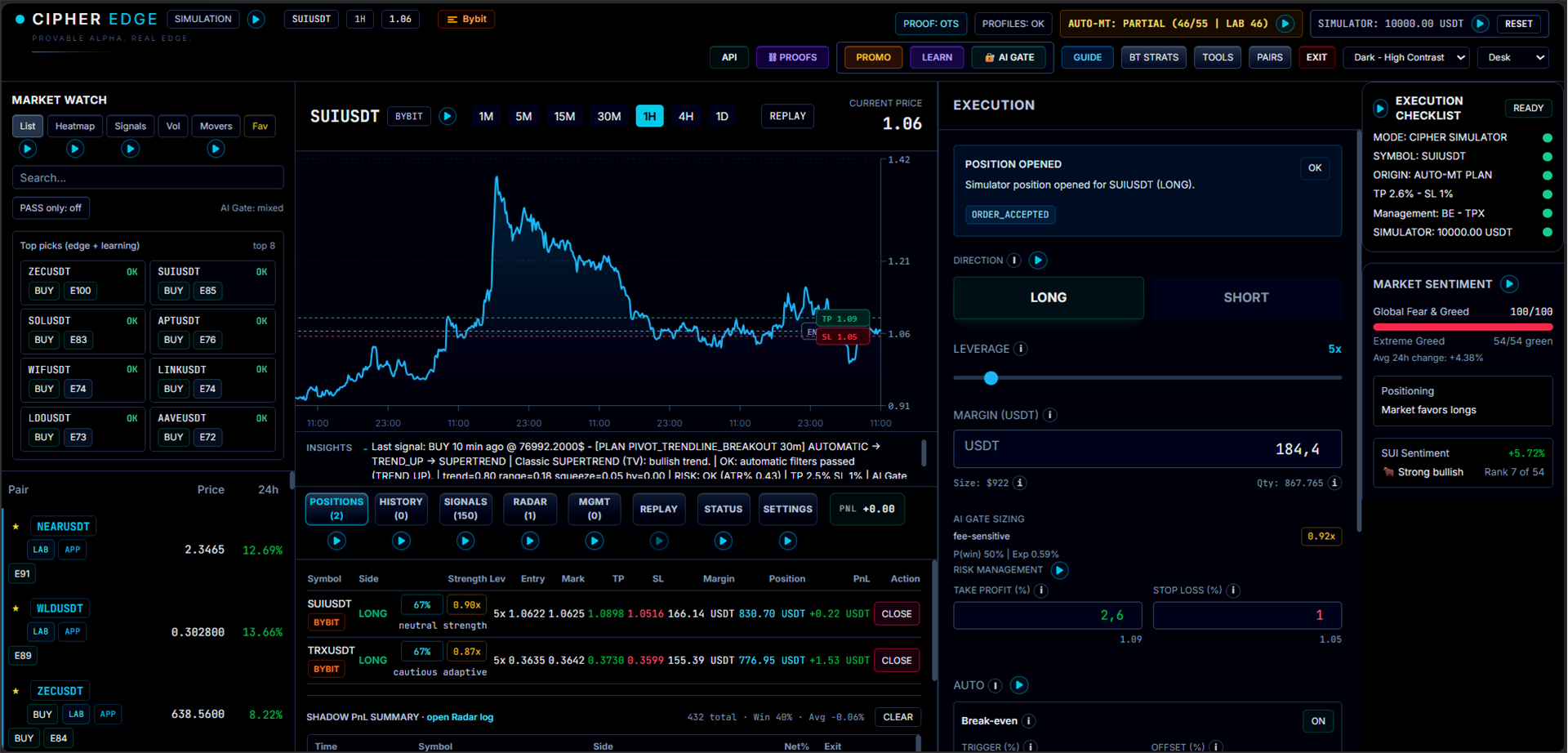
The terminal is the canvas. The real impact is in proof-backed alerts and reproducible Lab metrics.
This is the daily rhythm.
Proofs · metrics · flow

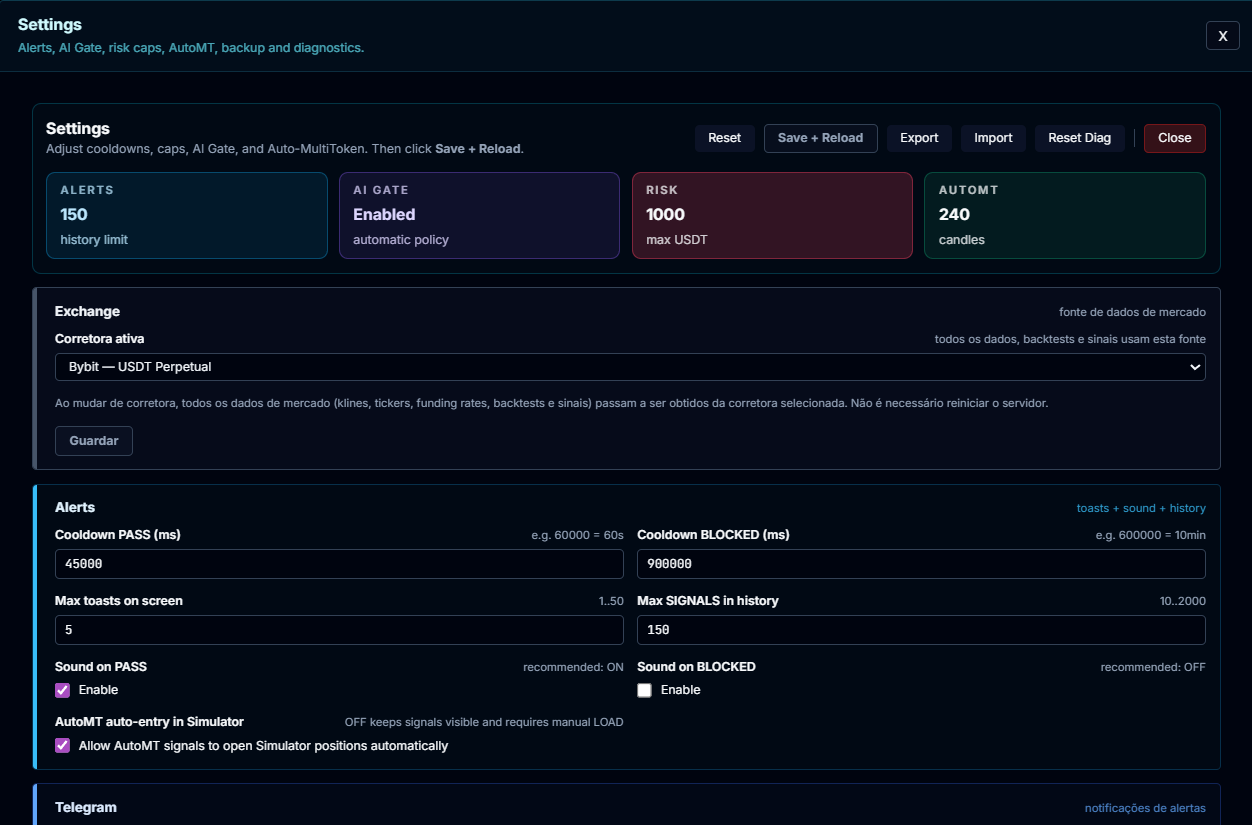
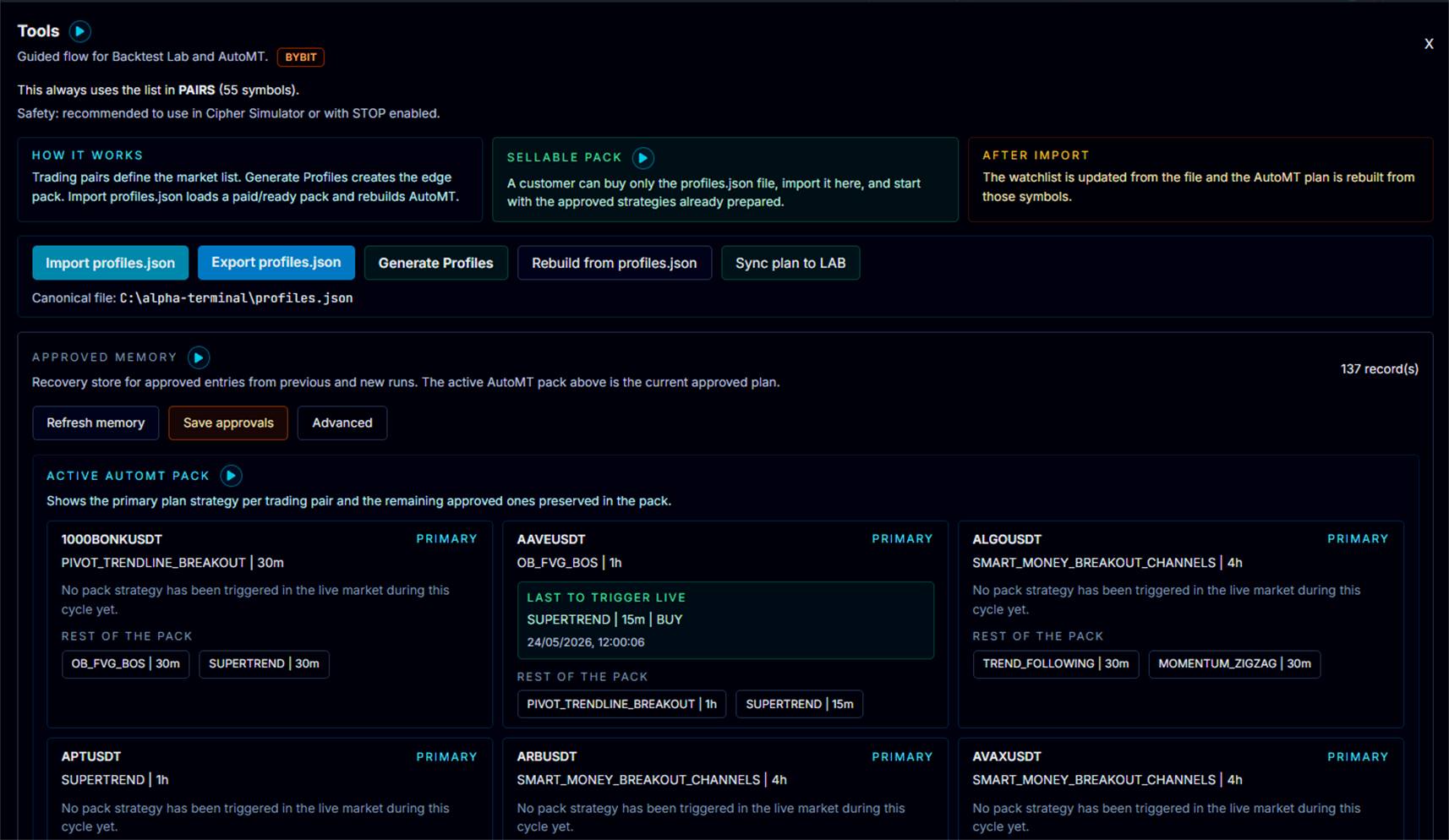
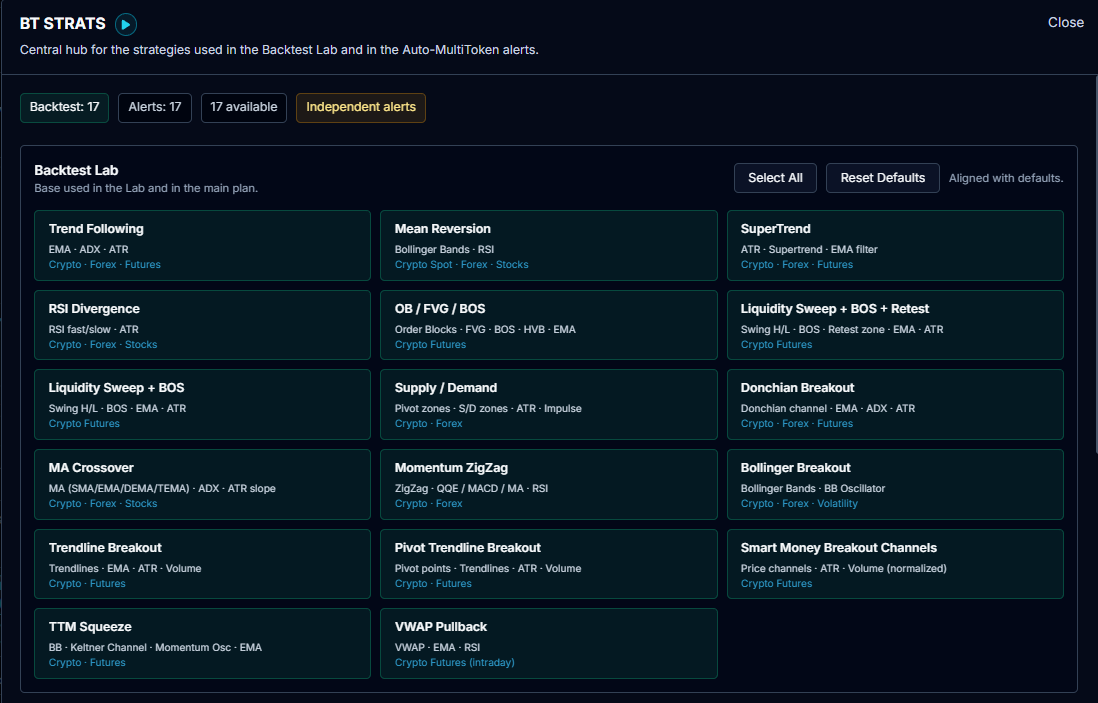
Native assistant for settings, diagnostics and workflow. It is not a chatbot pasted on top; it is part of the terminal, integrated into configuration and audit.

CIPHER explains settings, summarizes diagnostics, clarifies AI Gate behavior and helps keep the setup consistent before you save and reload. It is not a generic chatbot bolted onto the side: it is integrated into the terminal's real controls.
This is the provider-side audit trail, separate from the customer's local terminal workflow. The verifier on /proofs/ reproduces the public proof steps in the browser.
Strategy fires on a closed candle. We build a canonical leaf: lexicographic JSON of side, price, profile hash, candle close timestamp. Hash with SHA-256.
At UTC midnight we combine the official signals of the day into a binary Merkle tree (RFC-6962 domain separation). The 32-byte root represents the entire published day in one hash.
Cipher Edge submits the official Merkle root as transaction calldata on Base L2. Block timestamp = proof that the root existed before that block. Public anchoring is operated by Cipher Edge; customers do not need to pay gas to verify it.
The same root is also submitted to OpenTimestamps public calendars. Hours later, when the next batch is mined, the root is permanently witnessed by Bitcoin's proof-of-work.
Cipher Edge is not a broker, doesn't hold funds, and never connects to your exchange account without your explicit setup. The license unlocks the desktop package and profile delivery. Cancel any time — your local data stays yours.
Explore the terminal without a profiles.json. Check the interface, settings, public proofs and local workflow first.
Short paid access with the Cipher Edge reference beta pack. Useful before committing to a longer plan.
The default for active beta users. Includes the terminal and the Cipher Edge reference profile pack.
Best long-term value for a stable setup, beta pricing and occasional reference pack updates.
profiles.json is a Cipher Edge reference beta pack for selected liquid pairs, not a custom pack per customer.
/api/proof/roots: if it ever decreases, we've broken our own audit trail.
.zip (envelope.json + audit.json + receipt.ots). The CLI verifier (bin/verify-proof.ts) is <200 lines, uses only node:crypto + standard OpenTimestamps tools, and runs offline. As long as Base L2 and Bitcoin exist, you can verify our historical public signal trail forever — even if cipheredge.pt vanishes tomorrow.
docs/PROOF_LAYER.md. The strategy engine itself ships as compiled JS in the desktop package; design partners get source access under a separate agreement. Long term, the canonical leaf schema and verifier will be permanently open so anyone can build a third-party auditor.